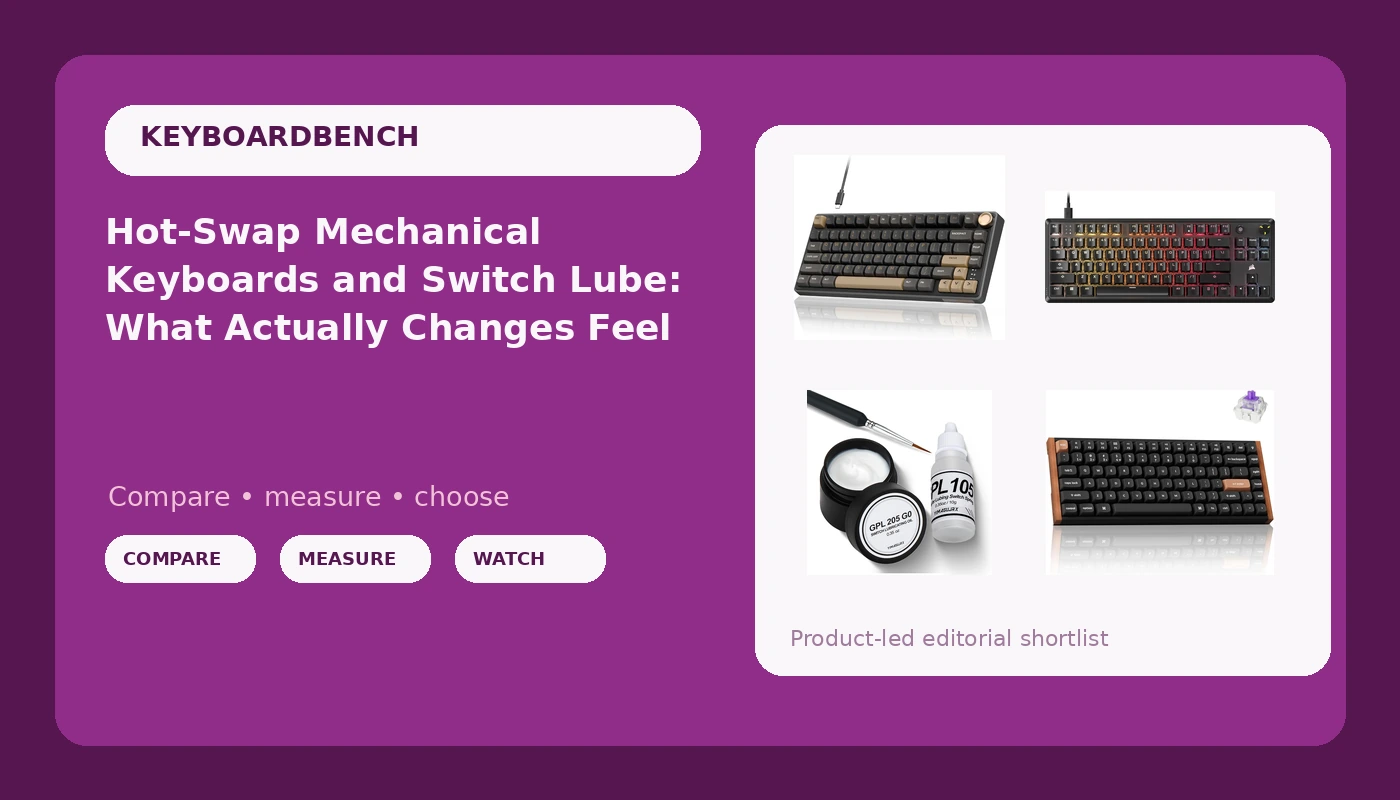
Most first-time buyers ask which switch is best, then buy whatever board happens to ship with it. That order is backwards. The more useful question is which board lets you change your mind later, and in 2026 that usually means one thing: a hot-swap mechanical keyboard. Pull a switch with a plastic puller, press in a different one, and you have effectively a new board without touching a soldering iron.
The four products below cover the full arc of that decision. There is a budget 75% board that already ships hot-swap, a tenkeyless board from a mainstream gaming brand, a wireless magnetic board built around rapid trigger, and the small tube of lube that fixes the thing factory boards most often get wrong. They are not really competitors. They are different stages of the same hobby, and knowing which stage you are in is most of the work.
Related: Switch Lube Basics: What GPL 205 G0 Actually Does →
Quick answer
Pick the layout and mounting you will live with daily, and confirm the board is hot-swap before anything else. The RK ROYAL KLUDGE R75 is the lowest-commitment way into a 75% gasket-mounted board with a volume knob. The Corsair K70 CORE TKL is the pick here if you want a tenkeyless board with pre-lubed linear switches from a mainstream gaming brand. The Keychron K2 HE is the one to look at if adjustable magnetic switches and rapid trigger are the features you actually want. The GPL 205 G0 and GPL 105 kit is not a board at all; it is the maintenance purchase that makes a budget board behave closer to an expensive one. Which of those you need depends on whether you are buying a first board, replacing a gaming board, or fixing the one already on your desk.
Four useful options
| Model | Best fit | What stands out |
|---|---|---|
| RK ROYAL KLUDGE R75 Wired Mechanical Keyboard with Volume Knob | First hot-swap board on a budget | 75% gasket mount, hot-swap sockets, volume knob, MDA profile PBT keycaps |
| Corsair K70 CORE TKL RGB Tenkeyless Mechanical Wired Gaming Keyboard | Replacing a full-size gaming board | Tenkeyless layout, pre-lubed MLX Red v2 linear switches, sound dampening, 1000Hz polling |
| GPL 205 G0 and GPL 105 for Mechanical Keyboard Switches Lube and Springs | Fixing rattle and scratch on a board you own | Two weights in one kit, 10g each, one for housings and one for springs |
| Keychron K2 HE Rapid Trigger Wireless Magnetic Custom Keyboard | Analog switches and rapid trigger | Wireless, magnetic switches, rapid trigger, customizable |
The entry point: RK ROYAL KLUDGE R75 Wired Mechanical Keyboard with Volume Knob
The R75 is the board I would hand someone who has never opened a keyboard. The reasoning is not about the switches it ships with, which are a linear silver, and it is not about the sound. It is that every decision you might regret later is reversible. If the linears feel too light, swap them. If the keycaps are not to your taste, they come off. The gasket mount and the PBT caps are the parts you cannot cheaply change, and those are the parts that are already decent here.
The trade-offs are the usual budget ones. Wired only, so no battery to worry about and no wireless convenience either. A plastic case. A volume knob that is genuinely useful and also the first thing to feel loose on any board at this price. None of that is a problem for a first board. It is a problem if you wanted one keyboard to be your last one.
The mainstream alternative: Corsair K70 CORE TKL RGB Tenkeyless Mechanical Wired Gaming Keyboard
This is the board for someone who wants a keyboard from a brand they already recognize, and there is nothing wrong with that. The pre-lubed MLX Red v2 linears are the notable part, because lubrication is the single biggest difference between a switch that feels scratchy and one that does not, and doing it at the factory means you never have to. Sound dampening inside the case and 1000Hz polling round out a package aimed at gaming first.
The honest trade-off is the keycaps. This board ships with ABS double-shot caps rather than PBT. ABS is fine to type on and it takes backlighting well, but it shines and smooths with use in a way PBT generally resists, and on a board in this tier that is the detail most likely to bother you a year in. If you care about keycap feel more than case material, that is worth weighing. It is also a wired board, like the R75.
The fix kit: GPL 205 G0 and GPL 105 for Mechanical Keyboard Switches Lube and Springs
If you already own a hot-swap board and something about it bothers you, this is where I would start, not with a new keyboard. Lubrication is the difference between a switch that sounds like plastic rubbing on plastic and one that sounds like a single clean event. The thicker grease goes on the parts that slide against each other; the thinner oil is for springs, where a heavy grease would deaden the return.
What lube will not do is fix a rattly stabilizer. Those are two different problems with two different fixes, and if your spacebar pings when you hit it, no amount of switch lube changes that. What this kit does do is make a set of cheap switches feel considerably less cheap, which is why it belongs in a conversation about buying boards. It also assumes you have a hot-swap board, because lubing soldered switches means desoldering every single one.
The analog option: Keychron K2 HE Rapid Trigger Wireless Magnetic Custom Keyboard
Magnetic switches are the one genuinely new thing in keyboards in the last several years, and rapid trigger is the reason people care. Instead of a metal leaf closing at a fixed point, a magnetic switch reports how far the stem has traveled, which means the actuation point is a setting rather than a physical property. Rapid trigger goes further: the key resets the instant you start lifting, so repeated presses in a game do not have to travel back through a fixed reset point first.
Whether that matters depends entirely on what you do. For typing, it is a curiosity. For competitive games where you tap the same key over and over, it is a real change in how the input behaves. The trade-offs are that magnetic switches are a different ecosystem from the mechanical switches the rest of this list uses, so your existing switch collection does not apply, and the software side is where the customization actually lives. This is also the only wireless board here, and wireless means a battery you have to think about.
Prices and availability may change. Product images, names, and retailer links are matched to verified listings. No current price, rating, stock status, or measured result is stated here without current evidence.
Why hot-swap matters more than the switch in the box
Almost every switch recommendation you read is really a recommendation about personal taste. Linears feel smooth and consistent, tactiles have a bump you can feel at the actuation point, clickies add an audible click on top of that. None of those is better than the others; they are different, and the only way to know which you prefer is to type on them for a while.
That is the argument for hot-swap. A board with hot-swap sockets treats switches as consumables. You can buy a ten-pack of something you have never tried, install it, type on it for a week, and decide. You can move that same set of switches into your next board. Without hot-swap, every switch experiment costs you a soldering iron, a desoldering pump, and an evening, which is enough friction that most people simply never experiment.
There is a second benefit that gets less attention: repairability. A single dead switch on a soldered board is an annoying repair. On a hot-swap board it is a thirty-second swap. If you plan to keep a keyboard for years, that matters more than any spec on the box.
What lube fixes, and what it does not
Factory switches are usually dry or lightly oiled, and dry plastic sliding on dry plastic produces the scratchy, slightly grainy feel that people describe as cheap. Lubrication fills the microscopic gaps between stem and housing, which smooths the travel and changes the sound from a rattle into something closer to a thock. It is a physical fix for a physical problem, not a matter of taste.
The two weights in a kit like this exist because different parts need different treatment. A thicker grease stays where you put it and works on the sliding surfaces of the housing and stem. A thinner oil is better for springs, where a heavy grease would slow the return and make the key feel sluggish. Applying too much is a real mistake; over-lubed switches feel mushy and lose their character.
What lube does not fix is stabilizers. Rattle comes from the wire inside the stabilizer moving against its housing, and it needs its own treatment, usually a thicker grease at the wire contact points and sometimes a mod to tighten the fit. A board with smooth switches and rattly stabilizers still sounds cheap.
- Decide whether you are buying a board or fixing the one you own, because those lead to different purchases.
- Confirm the board you are considering is hot-swap, since every later decision depends on it.
- Choose a layout by measuring your desk and your habits, not by what looks tidy in photos.
- Pick a switch type by trying one, not by reading descriptions of smoothness.
- Budget for lube and a switch puller at the same time as the board, because you will want both.
Practical guidance
- Buy a switch tester or a small pack of switches before committing to a full set for a board.
- Check that the board you want uses standard three-pin or five-pin switches so your later purchases fit.
- Treat the keycaps as part of the purchase, since ABS and PBT feel different within a month of use.
- If you already own a hot-swap board and dislike the sound, try lube before you try a new keyboard.
- Set a reminder to revisit your layout choice after a month, because numpad and arrow habits only show up in daily use.
Which option should you choose?
Choose the RK ROYAL KLUDGE R75 Wired Mechanical Keyboard with Volume Knob when you want a first hot-swap board in a 75% layout with a gasket mount and PBT keycaps, and you do not need wireless. Choose the Corsair K70 CORE TKL RGB Tenkeyless Mechanical Wired Gaming Keyboard when you want a tenkeyless board from a familiar gaming brand with pre-lubed linear switches and built-in sound dampening. Choose the GPL 205 G0 and GPL 105 for Mechanical Keyboard Switches Lube and Springs when you already own a hot-swap board and want to change how its switches feel without buying another keyboard. Choose the Keychron K2 HE Rapid Trigger Wireless Magnetic Custom Keyboard when adjustable actuation and rapid trigger are the features you are actually after, and you want to be wireless while using them.
One caveat worth stating plainly: nothing here is a measurement. Switch feel, sound, and stabilizer quality vary by unit, by desk, and by the person typing. The features listed are the ones the manufacturers document, and the fit suggestions are about matching a product to a job rather than ranking them against each other.
The bottom line
The keyboard market rewards patience more than budget. A hot-swap board, a switch puller, and a tube of lube get you further than spending the same money on a more expensive board with switches you cannot change. If you are starting out, pick a hot-swap board with a layout you can live with and accept that the switches inside are temporary. If you already have one, the cheapest improvement available is lubricating what you have. If you specifically want analog input and rapid trigger, that is a different product category with different trade-offs, and it is worth deciding that before you buy anything else.